Agata’s death
The PeasantsAgata’s death turns the final hours of a destitute beggar into a ritual of deliberate preparation, personal dignity, and communal recognition. Though the household is away at harvest when Jasio finds her collapsed at the threshold, she does not die unattended: she arranges her own last rites, receives the priest, and is mourned by the village. Her composed readiness gives way, at the moment of death, to Jasio’s unassuaged horror—a contrast that makes the scene both a communal ceremony and an intimate encounter with mortality.
Discovery and foreknowledge
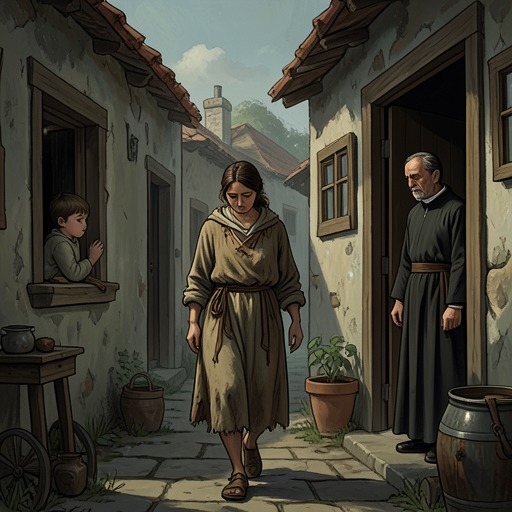
Jasio comes upon Agata by chance after leaving the hot, fly-filled house where Kozłowa had expected him to stay. Passing the Kłąbs’ open cottage, he hears groaning and finds Agata lying in the hallway beside the threshold. The house is empty because everyone has gone to the harvest. He carries her inside, lays her on a bed, gives her something to drink, and revives her until she opens her tearful eyes. Her first response is not panic but recognition: she tells him that her end is coming, smiling like a child newly awakened.
Jasio wants to fetch the priest, but Agata holds on to his cassock. She explains that the Lady has told her, “Prepare for tomorrow, weary soul!” She believes there is still time, and thanks God even as her voice weakens. Then, hands folded, she sinks into prayer, gazing as though toward a distance beyond the room. Jasio understands that she has begun to die and runs to summon the Kłąbs. Her foreknowledge shapes what follows: the next day is not simply an interval of waiting but the time she has set aside to put her affairs and body in order.
The funeral dowry and last rites
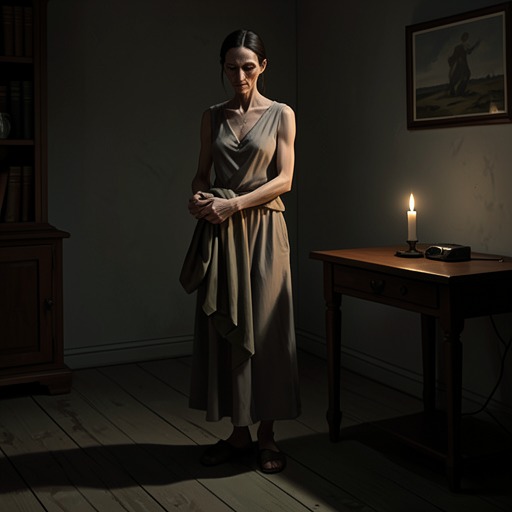
When Jasio returns that afternoon, Agata is conscious, with her chest beside her on the bench. From it she takes the things she has prepared over a lifetime of begging for this final hour: fresh bedding and a clean sheet to lie beneath her body, holy water, an aspergillum, a votive candle, a picture of the Lady of Częstochowa, a new smock, a fine wool skirt, a frilled cap, a headkerchief, and brand-new shoes. The array is at once practical and ceremonial. She spreads out each item, takes pleasure in it, and shows the treasures to the women, even trying on the bonnet and examining herself in a mirror. Her happy verdict is, “It will be grand. I’m looking at a fine housewife.”
Agata instructs the household to dress her in these clothes the following morning. Before then she has only a brief appetite for eggs, pecking at them once or twice before pushing them away. Later she quietly reassures Tomek that she will not remain in the way for long. In the morning, the others follow her directions: they dress her and lay her on Kłębowa’s bed, using Agata’s own bedding. She herself pats down the quilt, pours holy water onto a plate, and places the aspergillum beside it, checking that everything is ready for a farmer’s death in a farmer’s house. Only then does she ask for the priest.
The priest arrives with the Lord Jesus and prepares Agata for her final journey. He tells Jasio to remain beside her until the end because he must hurry elsewhere. Jasio reads quietly from the breviary; the Kłąbs stay at home, and Jagusia arrives and crouches silently in a corner. Agata holds a rosary and remains conscious, bidding farewell to those who come to the cottage. She gives the children gathered in the hallway and beneath the window a few groszy, asking them to pray for her. Her deathbed is therefore not sealed off from village life: even in her last hours, she gives what little she can and asks the next generation to remember her in prayer.
Death at sunset
Agata lies beneath the holy pictures, on the bed she had imagined for herself, with quiet pride and happiness. Tears gather in her grey eyes as she looks through the window toward the deep sky and the fields. Scythes are already flashing as they cut the ripe, heavy rye. The scene holds together the intimate stillness of the sickroom and the continuing work of harvest outside it: while one life is ending, the village’s seasonal labor proceeds. Her gaze seems to reach toward a place visible only to her dying soul.
As the day ends and the chamber fills with the red glow of sunset, Agata suddenly sits up, stretches out her arms, and cries, “It’s time for me, it’s time.” She falls back. The room erupts in wailing; those present kneel around the bed, Jasio begins the prayers for the dying, and Kłębowa lights the blessed candle. Agata repeats the prayers, growing weaker and less distinct, until she lets go of the candle and breathes her last. The carefully staged readiness of the morning thus meets an abrupt, bodily finality: the woman who arranged every detail can prepare for death, but cannot soften its arrival.
Communal honor and private terror
Ambrozy arrives just at the end and closes Agata’s eyes; Jasio says an ardent prayer over her. The whole village comes to pray beside her body, weep, and marvel—envying what the narrative describes as her happy death and easy ending. The social reversal is striking: the beggar woman dies “like the first lady of the village.” The burial clothes and ritual objects she had gathered through years of begging are not merely possessions; in the final scene they help her occupy, at least in death, a place of ceremony and honor within the community.
That shared reverence does not make death consoling to everyone. Looking into Agata’s lifeless eyes and at her face, stiffened by death, Jasio is overcome by terror. He flees home, throws himself onto the bed, buries his face in the pillow, and weeps. Jagusia follows despite her own grief and horror, wipes his tear-stained face, and comforts him as he leans against her like a child against his mother. The village can gather around a death and pray; Jasio still experiences the dead body as terrible and unbearable. Agata’s passing consequently holds two responses together: the communal recognition of a dignified end, and the raw private shock that no preparation or prayer can prevent.